

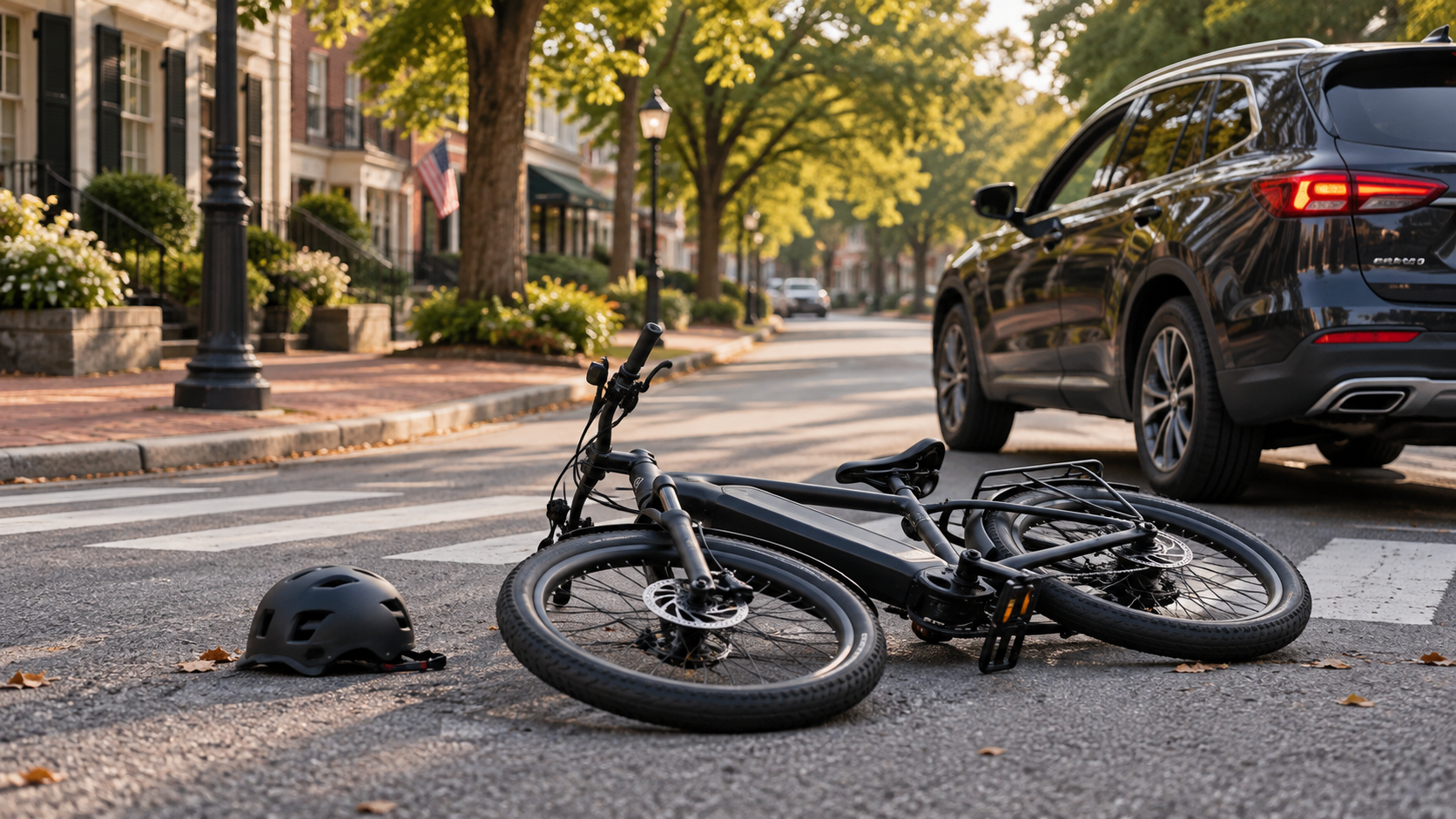
A driver hits you while you are riding an e-bike. You know what the driver did, and you believe the collision could have been avoided. Then the insurance company starts asking questions you did not expect: Was the e-bike registered? What type of e-bike was it? Did you have the required license?
Those questions have become more important since New Jersey's new e-bike licensing and registration requirements took effect in July 2026.
But they raise another question for an injured rider: Can a problem with registration, licensing, or another e-bike requirement change who is responsible for the crash? The answer depends on more than whether every rule was followed.
After an e-bike or bicycle-vehicle collision, the circumstances that caused the accident still matter. A driver's failure to yield, unsafe passing, distraction, or other conduct still has to be considered even when there is also a question about whether the rider complied with one of New Jersey's new requirements.
Understanding how those issues fit together can help you separate what actually matters to fault in an injury claim from a regulatory issue that may not have contributed to the collision.
What Changed for E-Bike Riders in New Jersey in 2026?
New Jersey significantly changed the rules governing electric bicycles in 2026.
Under current guidance from the New Jersey Motor Vehicle Commission, the general rule is that e-bike riders must be at least 15 years old and have either a valid driver's license or an e-bike license. E-bikes must also be registered with the MVC, and riders are required to wear helmets.
The insurance requirement depends on the type of bike.
The MVC distinguishes between a low-speed electric bicycle, which provides motor assistance only while the rider pedals and stops providing assistance at 20 mph, and a motorized bicycle, which can include certain bikes with higher pedal-assisted speeds or throttle-powered operation.
Motorized bicycles are required to carry insurance. Low-speed electric bicycles must be registered, but the MVC does not currently require them to be insured.
Those distinctions can become important after a crash because the specifications of the bike may determine which rules apply to the rider.
But they do not necessarily determine who caused the collision.
Does Breaking an E-Bike Rule Mean You Cannot Recover After a Crash?
Not automatically.
Suppose there is a question about whether an injured rider had completed the required registration, but the crash occurred when a driver drifted into the rider's path while passing. Or perhaps the insurer questions the rider's license even though the collision happened when a vehicle pulled from a driveway without yielding.
Those facts may become part of the investigation, but the existence of a regulatory violation does not, by itself, determine who was negligent. An important question is whether the violation had a connection to how the collision occurred.
New Jersey follows a comparative negligence system. Under N.J.S.A. 2A:15-5.1, an injured person's own negligence does not necessarily prevent recovery. If the injured person is found partly responsible, compensation is reduced by that person's percentage of fault. If the injured person's share of negligence is greater than the negligence of the party, or combined parties, from whom compensation is sought, recovery is barred.
That makes the connection between the violation alleged and the crash important.
For example, the fact that an e-bike was not properly registered does not, by itself, show that the registration issue contributed to a driver striking the rider. On the other hand, conduct by the rider that actually contributed to how the crash occurred may affect the analysis.
The facts have to be considered together.
When Could a Driver Be Responsible for an E-Bike Collision?
E-bike crashes can happen for many of the same reasons as other bicycle and motor vehicle collisions.
A driver may create a dangerous situation by:
- Turning across an e-bike rider's path without yielding
- Entering an intersection when the rider has the right of way
- Following too closely
- Passing an e-bike without the space or caution required under New Jersey's Safe Passing Law
- Looking at a phone instead of watching the roadway
- Backing from a driveway or parking space without seeing the rider
- Opening a vehicle door into the path of an approaching e-bike
New Jersey's Safe Passing Law specifically applies when motorists approach low-speed electric bicycles. When traffic and roadway conditions allow, a driver must move into a lane that is not adjacent to the rider.
If that is not possible, the driver must leave at least four feet while passing. If neither option can be used safely or lawfully, the driver must slow to 25 mph or the lower posted speed, be prepared to stop, and pass only when it can be done safely.
That does not mean speed automatically determines fault.
It means evidence showing where the vehicles were, how they were moving, and what each person had an opportunity to see can become especially important.
What Insurance May Be Available After an E-Bike Accident?
Insurance can be one of the more complicated parts of an e-bike injury claim.
If a negligent driver hits you, that driver's automobile liability coverage may be one potential source of compensation. Depending on the circumstances and the terms of the applicable policies, automobile coverage available to you or a member of your household may also need to be reviewed.
The e-bike itself matters too.
As of 2026, New Jersey requires insurance for motorized bicycles but not for low-speed electric bicycles. Determining exactly which category your bike falls into may therefore affect what coverage exists and how an insurer evaluates the claim.
This is one reason it can be important to preserve information about the bike rather than simply replacing or disposing of it after the accident.
The make, model, motor specifications, throttle capability, and other features may help establish how New Jersey law classifies it.
What Evidence Can Help Explain How the Crash Happened?
After a serious e-bike accident, the question of fault may eventually depend on much more than the driver's account and the rider's account.
Evidence can serve two different purposes after an e-bike crash.
Some evidence helps reconstruct the collision itself. That can include photographs, witness accounts, the police report, damage to the bike and vehicle, roadway marks or debris, and surveillance, dashcam, doorbell, or traffic-camera footage.
Other evidence may help establish which 2026 requirements applied to the bike. The make and model, motor specifications, throttle capability, manufacturer information, registration documents, and any modifications can help show whether the bike qualified as a low-speed electric bicycle or a motorized bicycle.
Medical records serve another purpose: documenting the injuries and treatment that followed the crash.
When Andres, Berger & Tran evaluates an e-bike injury claim, those different pieces of evidence can help answer separate but connected questions: how the collision occurred, which rules applied to the e-bike, and how the crash affected the injured rider.
Some of that evidence can disappear quickly. Private camera systems may overwrite footage, vehicles can be repaired, and physical conditions at the scene can change.
If you are physically able, identifying potential evidence early can help preserve a clearer picture of what happened.
What if the Insurance Company Blames You for an E-Bike Violation?
After a crash, an insurer may look closely at whether the rider was licensed, whether the e-bike was registered, how the bike was classified, where the rider was traveling, and whether other traffic rules were followed.
Those questions can be relevant, but they still have to be connected to the circumstances of the collision.
If an insurer argues that you violated an e-bike rule, the important question is not simply whether a violation occurred. It is also whether the conduct actually contributed to the crash and how that conduct compares with what the driver did.
That may require looking at vehicle speed, visibility, right of way, passing distance, traffic signals, the position of the e-bike, and what each person reasonably had an opportunity to see and do before impact.
An allegation that the rider broke a rule should therefore be evaluated in the context of the entire accident rather than treated as an automatic answer to who was responsible.
Injured in an E-Bike Accident in New Jersey?
An e-bike crash can leave you trying to manage medical treatment and recovery while also sorting through unfamiliar questions about registration, licensing, insurance, and fault.
At The Law Offices of Andres, Berger & Tran, we investigate serious personal injury claims by examining how the accident happened, what insurance coverage may be available, and the facts that could affect responsibility.
If you or a loved one was injured in an e-bike accident in Camden, Burlington, or Gloucester County, elsewhere in South Jersey, or anywhere else in New Jersey, contact Andres, Berger & Tran to discuss what happened and learn more about your legal options.
Disclaimer: This blog is provided for general informational purposes only and is not a substitute for legal advice based on your individual circumstances. Reading this article does not create an attorney-client relationship. If you need legal advice, please contact our law firm directly.